

How SEBI’s revised KYC framework opens new opportunities for overseas investors and Indian financial institutions while strengthening identity verification and regulatory accountability.
India’s capital markets are becoming more accessible to investors living overseas.
On 4 November 2026, the Securities and Exchange Board of India (SEBI) introduced a revised Know Your Client (KYC) framework, effective 3 December 2026, allowing eligible Non-Resident Indians (NRIs), Overseas Citizens of India (OCIs) and foreign nationals residing in Financial Action Task Force (FATF)-compliant countries to complete digital KYC remotely.
Until now, the requirement for customers to be physically present in India during digital KYC created practical challenges for overseas investors. Account opening often involved physical documentation, attestation, international couriers and extended processing timelines. The revised framework changes this equation.
For investors, it offers greater accessibility and convenience. For financial institutions, it creates opportunities to accelerate onboarding, reduce operational friction and strengthen identity assurance.
What Has SEBI Changed?
The circular relaxes the physical-location requirement for digital KYC of eligible individuals residing outside India.
SEBI-registered intermediaries, including stockbrokers, depository participants, asset management companies and portfolio managers, can now facilitate remote digital onboarding, subject to prescribed verification requirements.
The framework introduces several important provisions:
- Remote digital KYC: Eligible overseas investors can submit KYC information and supporting documents digitally.
- Video In-Person Verification (VIPV): Live video verification can be undertaken where physical verification is not feasible.
- Digital documentation: Permitted electronic documents and signatures can support customer verification.
- KYC record reuse: Existing information can be retrieved through KYC Registration Agencies (KRAs) and the Central KYC Records Registry (CKYCRR).
- Remote re-KYC: The framework also supports KYC updates for eligible existing overseas customers.
Importantly, SEBI has enabled an additional digital verification pathway, not mandated that every intermediary adopt a new Video KYC solution.
The intermediary continues to be responsible for customer due diligence, verification and compliance.
What Does This Mean for Overseas Investors?
Consider an NRI professional living in Dubai who wants to open an Indian trading account or invest in mutual funds.
Previously, completing KYC could involve printing documents, obtaining attestations and sending paperwork internationally. An otherwise digital investment journey could become lengthy and inconvenient.
Under the revised framework, eligible investors may complete the necessary verification remotely, depending on the intermediary’s onboarding process.
This creates three meaningful benefits.
Greater accessibility: Investors can initiate and complete eligible KYC journeys without travelling to India solely for verification.
Reduced paperwork and delays: Digital submission, remote verification and reuse of existing KYC information can minimise physical documentation and repeated follow-ups.
A more convenient investment experience: Simplified onboarding can make participating in Indian financial markets easier for overseas customers.
While some verification routes may still require certified documents, the framework provides institutions with greater flexibility to reduce unnecessary physical touchpoints.
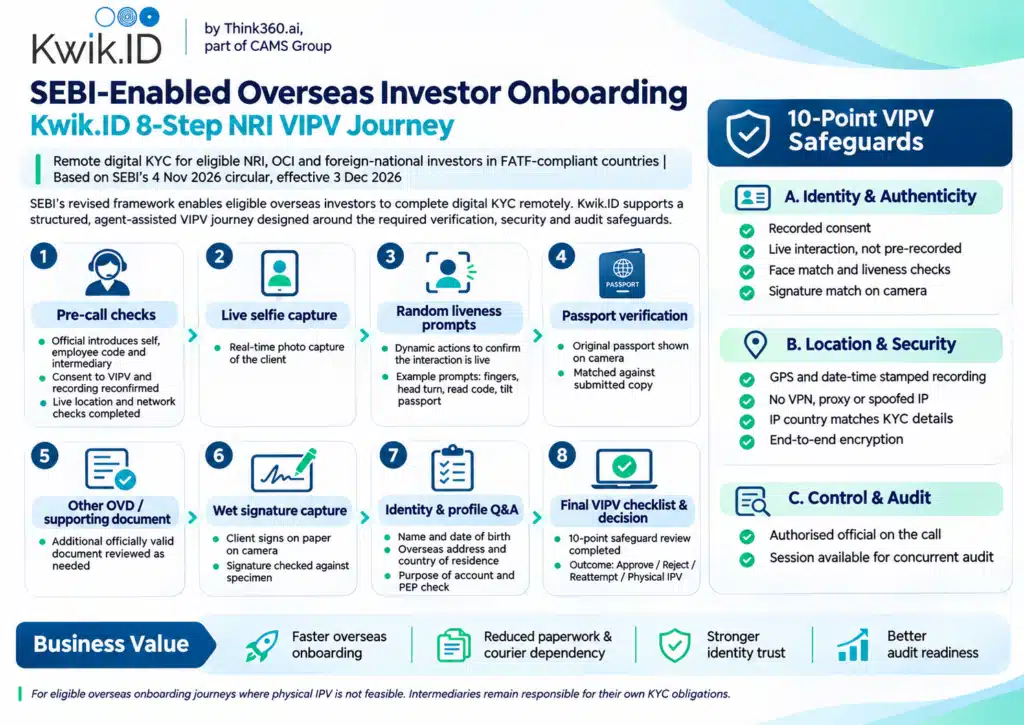
The Business Opportunity for Financial Institutions
For brokers, depository participants, AMCs and wealth-management firms, the opportunity extends beyond accommodating a regulatory change.
It is an opportunity to rethink overseas investor acquisition and servicing.
Faster onboarding and improved conversions
Lengthy verification journeys increase the possibility of incomplete applications and customer abandonment.
Remote digital verification can reduce onboarding friction, shorten turnaround times and potentially improve account-opening conversions.
Lower operational costs
Manual document collection, verification, courier coordination and exception handling require significant operational effort.
Streamlined digital workflows can reduce repetitive activities, improve processing efficiency and help institutions scale NRI onboarding without proportionate increases in manual workload.
Expanded overseas investor reach
Intermediaries with NRI investment services can offer more accessible onboarding experiences across eligible international markets.
This may support customer acquisition, improve service accessibility and create opportunities for growth.
Stronger compliance oversight
Structured digital verification processes can capture consistent evidence of identity checks, customer consent, verification decisions and audit activities.
This strengthens operational visibility and supports regulatory accountability.
The business opportunity lies in combining investor convenience, operational efficiency and identity trust within a single onboarding journey.
SEBI's Ten VIPV Safeguards: Building Trust Without Physical Presence
Remote onboarding introduces challenges that cannot be addressed through a basic video call.
How can institutions verify that a person is genuine? How can they establish the customer’s location? How can they demonstrate that verification was conducted securely?
SEBI addresses these questions through ten safeguards for Video In-Person Verification.
They can be understood across three areas.
Identity and authenticity
The framework requires random live actions, clear facial capture, photograph matching, face liveness verification and spoof detection.
These safeguards help protect against impersonation, manipulated video interactions and identity fraud.
Location and security
Verification must include live GPS coordinates, timestamps, protection against VPN/proxy and spoofed-IP connections, and checks that the customer’s IP country corresponds with the applicable KYC information.
End-to-end encryption is also required to protect the verification interaction.
Consent and auditability
Customer consent must be recorded in an auditable, alteration-resistant manner. The intermediary’s authorised official must participate in the VIPV session, and the process is subject to concurrent audit.
Together, these safeguards establish an important principle:
Digital trust requires more than successful identity verification. It requires reliable evidence of how that verification was performed.
From Regulatory Requirements to Digital Onboarding Infrastructure
Meeting the revised framework involves more than adding Video KYC to an existing investment application.
Intermediaries must connect identity verification, document collection, location checks, consent capture, fraud controls and audit workflows with their existing KYC infrastructure.
A well-designed onboarding journey should address three objectives simultaneously:
- Customer experience: Minimise unnecessary steps, repeat documentation and verification delays.
- Identity assurance: Use secure video interactions, AI-powered face matching, liveness and anti-spoofing capabilities to establish authenticity.
- Operational accountability: Maintain verification records, audit evidence, exception-handling processes and regulatory controls.
This is where integrated digital identity platforms can contribute meaningful value.
Rather than managing disconnected verification tools and manual processes, institutions can build more consistent, secure and scalable onboarding experiences.
The Road Ahead: Making Digital Trust Borderless
SEBI’s revised NRI KYC framework represents an important step towards more accessible participation in India’s capital markets.
For overseas investors, it can simplify the journey from investment interest to account activation.
For financial institutions, it offers an opportunity to improve acquisition, conversion and operational efficiency while maintaining robust verification standards.
At Think360.ai, part of CAMS Group, these developments reinforce the importance of AI-powered digital identity infrastructure. Through KwikID, the focus is on enabling secure, agent-assisted Video KYC, intelligent identity verification and auditable onboarding workflows that support evolving regulatory requirements.
The broader opportunity is not simply to digitise an existing KYC process. It is to make identity verification more accessible, reliable and scalable.
Because when trust can be established securely across borders, access to financial opportunities can become simpler for everyone.
Regulatory reference: SEBI circular dated 4 November 2026, “Review of Know Your Client process for individual Person Resident Outside India clients,” effective 3 December 2026. This article is intended for informational purposes and does not constitute regulatory advice or imply SEBI endorsement of any technology provider.